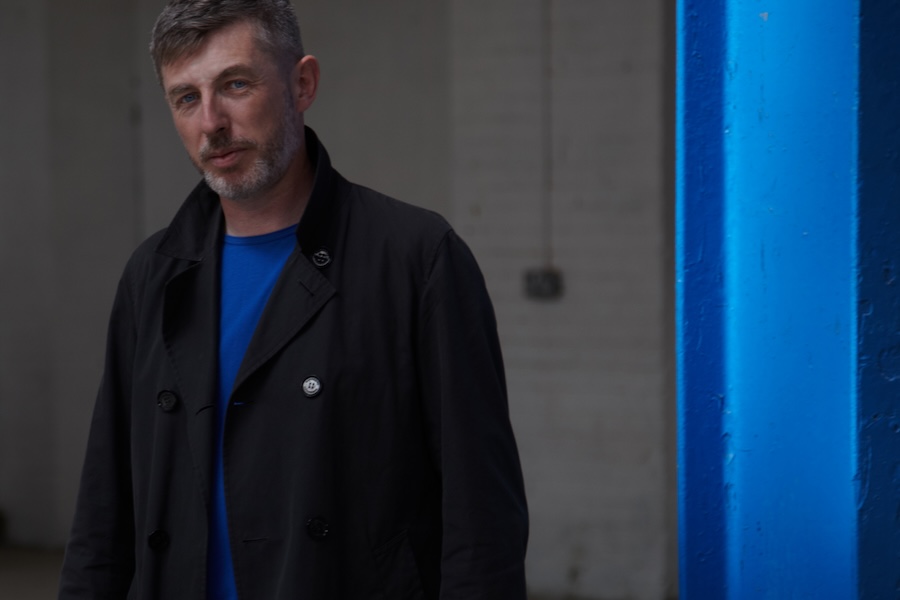
After twenty five years of building a distinct world under the Nebraska name, the producer steps forward with Dubl Drat, a new alias that feels less like a break and more like a shift in perspective. Across this conversation, he reflects on his new EP, the past, reshaping familiar materials, and the creative impulses guiding this next chapter.
WWD: Nebraska to Dubl Drat feels like both a reset and a continuation. What moment made you realise it was time to retire the Nebraska alias and step into this new identity?
We live in a vastly changed world from the one in 2000, when I randomly picked the name of a US state purely for the way the name sounded. It was less of a specific moment or single reason, but more a growing feeling that it would be good to mark over 25 years of Nebraska and to embark on the next chapter. Dubl Drat references the Drat And Double Drat catchphrase of 70s cartoon character Dick Dastardly. The image of him with his sidekick dog Muttley reminded me of me and my dog. I spell it differently to avoid any overlap with anyone or anything else.
WWD: You have said the cut and paste ethos remains the same. What does that ethos mean to you now compared to 25 years ago?
It is something I have always intuitively reached for, whether musically or visually. From a music perspective, it actually becomes a way of listening to and looking for records, digging I guess. As regards what it means today rather than in the past, I think it is the same thing, only more so. In a world where everything is abundant, you may as well start with what is already there.
WWD: The EP is described as a transmission from both sides of your creative psyche. How consciously were you switching between Nebraska and Dubl Drat while making these tracks?
That is something that is really hard for me to discern. Obviously, they are both me. I think what is becoming a recurring feature of my work is striving for a clarity of musical and sonic purpose, whilst at the same time echoes of my trip hop 90s are reverberating.
WWD: ‘Alter Alter Ego’ appears twice, once as the Nebraska OG Mix and once as the Dubl Drat Remix. What does each version reveal about the two personas?
The earliest version is perhaps closer to the sampled breakbeats aesthetic of the first Nebraska records, whereas later mixes of the track were reaching for something more stripped out and sparse. I think that might be the clue to what is to come from Dubl Drat, but we will see.
WWD: ‘Olive’ also exists in two forms, the Dubl Drat Dub and the Nebraska Version. How did you approach reshaping the same material from two different angles?
The first version establishes a kind of base camp, a point from which further explorations can be made. That is the way I approach versioning a tune. It is good to extrapolate further after you have ostensibly finished a piece of work, to see what else might be found.
WWD: The Dubl Drat material leans into dubbed out abstraction, granulated percussion and dissolving structure. What draws you to those more vaporous immersive sound worlds?
I make a chunk of my music physically standing up in my studio, and then some of it lying on the sofa in the evening. I suspect these two states, often employed on the same track, inform this. I am usually aiming to engage the listeners head via their hips, and vice versa.
WWD: Conversely, the Nebraska tracks still carry that warm groove led Rhodes flecked DNA. What keeps you connected to that lineage even as you evolve?
It is just a genuine love for those sounds and textures. It is what I loved when I heard golden era hip hop producers sample it, even back to Peter Piper by Run DMC. I loved it when I heard Moodymann Black Mahogany. I love it on Herbie Hancock and Weather Report LPs. It is classic.
WWD: ‘The Teckel Track’ has this hazy slo mo bumpy groove. Where did that mood come from, a studio accident, a deliberate palette or something else?
I have been listening to old tracks like Don’t Stop the Music by Yarborough and Peoples, and those cosmic sounding slower disco tracks like Cloud 9 Strut by Patrick Adams. Also that world of P funk synth bass, Bernie Worrell, Zapp. I had figured out some chords on guitar, and though the guitar is not on the final track, those chords implied the bass line.
WWD: You mentioned that Nebraska was chosen randomly decades ago. How does choosing a more abstract alias like Dubl Drat change the way you think about your music identity?
I think it was more the feeling that I was done with the Nebraska name, to be honest. Though I have been using it for 25 years, there are a lot of other Nebraskas out there. That said, a new name and graphic identity does provide a moment to refocus, which is great.
WWD: Does stepping away from a geographically loaded name free you creatively, or was it more about acknowledging how the world and the scene have changed?
I think the geographic associations with the name are part of it. I have had a few nice messages from Nebraska residents over the years, which I am truly touched by, given that I randomly picked that word having no real idea what it related to geographically or otherwise. But yes, it feels good to have a new way of presenting the work after all these years.
WWD: The EP feels very tactile, chopped breaks, flickering Rhodes granulated textures. What tools or workflows shaped this record?
Workflow is pretty grandiose in terms of describing what I actually do. Really, it is often as basic as me buying lots of cheap second hand vinyl, often from charity shops rather than record stores. Then it is a turntable and a laptop. Most of the effects and synths are the most basic ones shipped with Ableton. I sometimes sketch chords on acoustic guitar and record them with my iPhone, often discarding them once transcribed to keys. There is no great secret method or magic piece of gear.
WWD: You have always had a strong sampling sensibility. How has your relationship with sampling evolved from the early 90s to this EP?
Anyone involved long term in sampling eventually gets a reality check rather than a royalty cheque. I will leave it at that.
WWD: This EP marks the final Nebraska release. How does it feel to close that chapter, and what do you hope listeners take from this last transmission?
I feel great about it. Really happy with nearly everything realised under that name, and it seems that most of the music is not particularly locked to a time or place. The music does not go away. Even if it is not streamable, downloadable or on YouTube, you can still get out and dig for the records, right?
WWD: Looking forward, what excites you most about exploring Dubl Drat without the weight of a legacy alias behind you?
Just making new music, with renewed clarity of purpose.
WWD: If you could describe the relationship between Nebraska and Dubl Drat in one sentence, a conversation, a tension, a handover, what would it be?
The common theme is that sampling is somehow always about dealing with the past in the present. I think Dubl Drat has a clearer, less cluttered view on what the future of that is.
WWD: Can’t wait to hear it! Thanks for the chat 🙂
‘The Alter Alter Ego’ EP is available here